
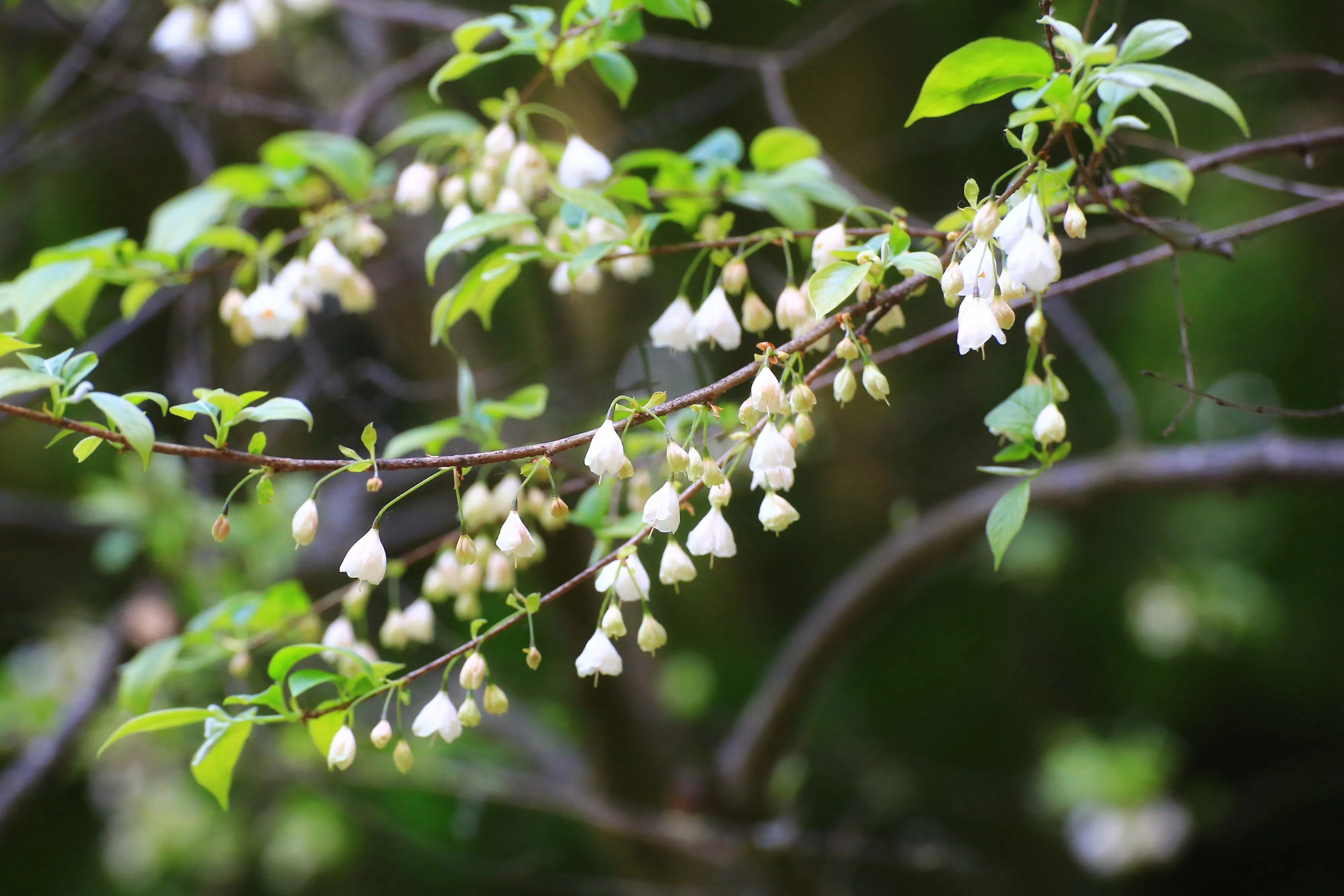
By MIKE RALEY WPTF Weekend Gardener
Alas, another plant I have never owned and rarely seen in the landscapes in the Triangle. Of course, I normally don’t trespass to look for plants so there may be a lot more out there than I realize. One of the reasons may be that the Carolina Silverbell (Helesia carolina), a native flowering tree, is more plentiful in the mountains of North Carolina. They do seem to adapt well to the growing conditions in the piedmont. Most of the experts on the “Weekend Garden” have never seen it in the wild or in the home landscape. You would most likely see them in the Great Smoky Mountains on slopes and creek banks. That environment is hard to duplicate in the home garden. It can be done if you can find one at your local nursery.
The flowers of the Silverbell are the main draw for adding this tree to your landscape. Flowers are white, bell-shaped clusters that droop. The flowers appear before the leaves in early spring and attract pollinators like bees, hummingbirds and butterflies. It is a larval host for the Eastern Tiger Swallowtail.
Generally, the Silverbell likes to grow in full sun to partial shade and will thrive in moist, yet well-drained acidic soil. Water your Silverbell regularly for the first year in your landscape as they do not like drought. The extension service folks tell me that this tree can grow to about 30 feet tall and is long-lived if you plant it in the right place and keep it happy. It will probably be happiest west of the Triangle. The Silverbell’s leaves turn yellow in the fall and then interesting seed pods appear. They are yellow-green in the late summer and then turn brown in the fall.
There are several cultivars you might be able to find at a nursery in your area, or order from a reliable source. They include: “Arnold Pink”, “Crushed Velvet”, “Rosea”, Silver Splash”, “Variegata”, “Wedding Bells”, and “Meehanii”.
As with pretty much all trees and shrubs, the bottom of their resting place should not be deeper than the root ball’s length. The hole should be twice the diameter of the root ball. Add some composted material like North Carolina-based Daddy Pete’s. They prefer a neutral pH but will take some acidity in the soil. Water the plant well and cover with native soil. Tamp it down well to prevent air pockets in the soil which can prevent good drainage and ruin the roots. Add about three inches of hardwood mulch, pine straw or pinball chips to the base of the tree to help hold moisture and protect the root system. Don’t pile it up any higher as it’s no need to overdo it. Pull the mulch away from the trunk to protect it.
The Silverbell has year-round interest and that makes it valuable for our landscapes if we have the right growing conditions. If you choose to plant one of the varieties I’ve listed, it’s likely you will be the first in your neighborhood or town to own one of these unique beauties, and in the horticulture world, that’s saying something.